The Real Difference Between AI, Machine Learning, and Deep Learning
By
Karson Felix
July 20, 2026
Latest
Artificial intelligence has become one of the most talked-about technologies of the modern era. Yet despite its growing presence in everyday life, many people still use the terms AI, machine learning, and deep learning interchangeably.
While these concepts are closely related, they are not the same thing.
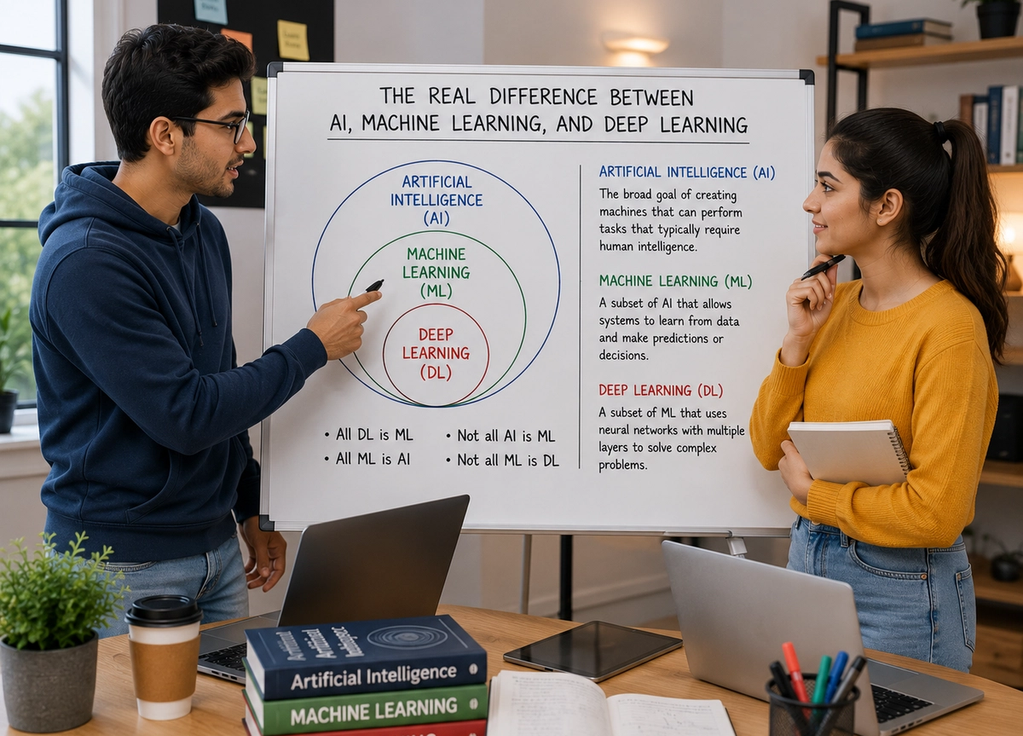
Understanding the difference doesn’t require a computer science degree. In fact, the relationship between them is fairly simple once you break it down. Think of them as nested categories: deep learning is a type of machine learning, and machine learning is a type of artificial intelligence.
Here’s what each term actually means and why the distinction matters.
What is artificial intelligence?
Artificial intelligence, or AI, is the broadest category of the three.
AI refers to any technology designed to perform tasks that typically require human intelligence. These tasks might include understanding language, recognizing images, making decisions, solving problems, or learning from experience.
The idea of AI has existed for decades, long before modern tools like chatbots and image generators appeared. Even relatively simple systems that follow predefined rules can fall under the umbrella of artificial intelligence.
In other words, AI is the overall goal: creating machines that can perform intelligent tasks.
Machine learning and deep learning are two of the approaches used to achieve that goal.
What is machine learning?
Machine learning is a subset of artificial intelligence.
Instead of programming a computer with every possible rule it might need, machine learning allows systems to learn patterns from data. The more data the system analyzes, the better it can become at making predictions or identifying relationships.
For example, imagine you want a computer to recognize spam emails.
Rather than manually creating thousands of rules about what spam looks like, you can provide the system with large numbers of examples of spam and non-spam messages. Over time, it learns the patterns that distinguish one from the other.
Machine learning is used in many everyday technologies, including:
- Recommendation systems
- Fraud detection
- Search engines
- Personalized advertising
- Predictive analytics
The key idea is that the system improves through experience rather than relying solely on explicit instructions.
What is deep learning?
Deep learning is a specialized type of machine learning.
It uses structures called artificial neural networks, which are loosely inspired by the way the human brain processes information. These networks contain multiple layers that allow them to identify increasingly complex patterns within large datasets.
This layered approach is where the term “deep” comes from.
Deep learning excels at tasks involving enormous amounts of data, such as:
- Image recognition
- Speech recognition
- Language translation
- Self-driving vehicle systems
- Generative AI tools
Modern applications like voice assistants, image generators, and advanced chatbots rely heavily on deep learning techniques.
Without deep learning, many of today’s most impressive AI systems would not be possible.
A simple way to think about it
One of the easiest ways to understand the relationship is to imagine three circles.
The largest circle is artificial intelligence.
Inside that circle is machine learning.
Inside the machine learning circle is deep learning.
In other words:
- All deep learning is machine learning.
- All machine learning is AI.
- Not all AI is machine learning.
- Not all machine learning is deep learning.
This hierarchy helps explain why people often confuse the terms. Deep learning applications are some of the most visible examples of AI today, but they represent only one part of a much larger field.
Why deep learning became so popular
Although artificial intelligence has existed as a concept for decades, deep learning has driven many of the breakthroughs that captured public attention in recent years.
Several factors contributed to its success:
- Massive amounts of digital data
- More powerful computer hardware
- Improved algorithms
- Greater access to cloud computing
These developments allowed neural networks to process information at scales that were previously impossible.
As a result, AI systems became significantly better at recognizing images, understanding language, generating content, and performing tasks that once seemed uniquely human.
Much of the current excitement surrounding AI is actually excitement about advances in deep learning.
Why the distinction matters
For most people, understanding the difference between these terms won’t change how they use technology day to day. However, it can help make discussions about AI more accurate.
When news articles describe advances in AI, they are often referring specifically to machine learning or deep learning systems. Understanding this distinction provides a clearer picture of what the technology is actually doing and how it works.
It also highlights an important reality: artificial intelligence is not a single technology. It is a broad field that includes many different methods, approaches, and applications.
Knowing the terminology helps separate hype from reality.
The future of intelligent systems
As AI continues to evolve, machine learning and deep learning will likely remain central to many technological advancements. From healthcare and education to transportation and scientific research, these tools are already influencing countless industries.
At the same time, researchers continue exploring new approaches that may eventually go beyond today’s machine learning techniques.
The field is still developing, and many breakthroughs are likely still ahead.
Understanding the building blocks
Artificial intelligence, machine learning, and deep learning are often discussed as though they mean the same thing, but they represent different layers of the same technological landscape.
AI is the broad goal of creating intelligent systems. Machine learning is a method that allows systems to learn from data. Deep learning is a more advanced form of machine learning that uses layered neural networks to solve complex problems.
Understanding these distinctions makes it easier to follow conversations about technology and appreciate the innovations shaping the modern world.
While the terminology can seem confusing at first, the relationship between the three is actually quite straightforward once you see how the pieces fit together.