The Quiet Death of the 9-to-5
By
Enzo Hinton
July 21, 2026
Latest
For decades, the traditional 9-to-5 job represented the standard model of work.
Employees commuted to an office, worked fixed hours, and returned home at the end of the day. The arrangement wasn’t perfect, but it provided structure, predictability, and a clear separation between professional and personal life.
Today, that model is quietly changing.
The shift didn’t happen all at once, and in many industries the traditional workday still exists. Yet across large parts of the economy, the idea of working from 9 a.m. to 5 p.m. in a single location is becoming less common. Remote work, flexible schedules, freelance careers, hybrid workplaces, and global teams are reshaping what work looks like for millions of people.
The 9-to-5 isn’t disappearing entirely—but its dominance is fading.
Technology changed where work happens
One of the biggest reasons for this shift is technology.
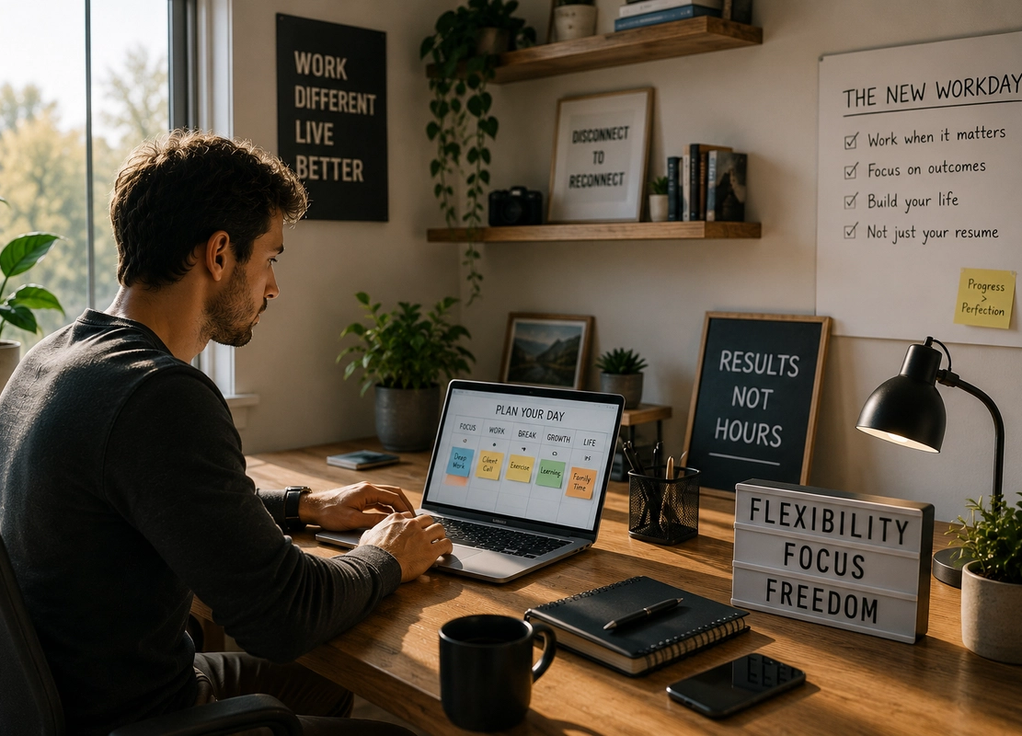
For many professions, work is no longer tied to a physical location. Laptops, cloud-based software, video conferencing tools, and high-speed internet have made it possible to collaborate from almost anywhere.
Tasks that once required a dedicated office can now be completed from home, a coworking space, a coffee shop, or even another country.
As organizations became more comfortable with digital collaboration, many began questioning whether employees needed to be physically present every day to be productive.
The answer, in many cases, was no.
The pandemic accelerated an existing trend
Remote work existed long before 2020, but the global pandemic dramatically accelerated its adoption.
Organizations that had previously resisted flexible work arrangements were forced to experiment with them. Employees and employers alike discovered that many jobs could continue functioning effectively outside traditional office environments.
Not every company embraced permanent flexibility, but the experience changed expectations.
Workers became more aware of the benefits of remote and hybrid arrangements, while employers gained firsthand experience managing distributed teams.
The result was a lasting shift in how many people think about work.
What began as a temporary adjustment became a long-term transformation.
Flexibility has become a priority
For many workers, flexibility is no longer considered a bonus.
It has become a major factor in career decisions.
People increasingly value the ability to adjust schedules, work remotely, reduce commuting time, and balance professional responsibilities with personal commitments. Parents, caregivers, students, entrepreneurs, and professionals pursuing side projects often find flexible arrangements particularly appealing.
This doesn’t mean people want to work less.
Rather, many want greater control over when and where work happens.
The focus is shifting from hours spent at a desk to outcomes and results.
Work and life have become more interconnected
The traditional 9-to-5 created a clear boundary between work and personal life.
Flexible work arrangements offer many advantages, but they have also blurred those boundaries. Emails arrive after hours, messages appear on weekends, and work can follow employees wherever they go.
In some ways, the decline of the 9-to-5 has created both freedom and complexity.
People may have more control over their schedules, but they often need to establish their own boundaries to avoid constant connectivity.
The challenge is no longer simply finding time to work.
It’s finding time to stop working.
The rise of independent work
Another factor contributing to the decline of the traditional workday is the growth of independent careers.
Freelancers, consultants, content creators, contractors, and small business owners often operate outside conventional schedules. Their work may happen early in the morning, late at night, or at various times throughout the day.
Digital platforms have made it easier for individuals to find clients, sell products, build audiences, and create income streams without relying exclusively on traditional employment.
As a result, more people are designing careers around their lifestyles rather than organizing their lives around a fixed schedule.
The definition of work is becoming more flexible.
Employers are adapting too
Organizations are responding to these changes in different ways.
Some companies have embraced remote-first models. Others have adopted hybrid arrangements that combine office and remote work. Some continue to prefer traditional office environments but offer more flexibility than in previous decades.
The competition for talent has played a role in this evolution.
Employers increasingly recognize that flexibility can be a valuable recruitment and retention tool. Candidates often compare workplace policies just as carefully as they compare salaries.
In many industries, rigid schedules are becoming harder to justify when flexible alternatives exist.
Not every job can move away from the 9-to-5
Despite these changes, it’s important to recognize that many professions still depend on fixed schedules.
Healthcare workers, teachers, retail employees, hospitality staff, emergency responders, manufacturing workers, and countless others perform roles that require physical presence and structured hours.
The decline of the 9-to-5 is not universal.
Instead, it primarily affects sectors where technology enables greater flexibility.
The future of work is unlikely to involve a single model. Different industries will continue to operate in different ways based on their unique requirements.
The future of work may be more personalized
Perhaps the most significant change is that work is becoming more individualized.
Rather than following a single standard schedule, people increasingly have options. Some thrive in traditional office environments. Others prefer hybrid arrangements. Some choose fully remote work, while others build careers through freelancing or entrepreneurship.
The future may not involve replacing one model with another.
Instead, it may involve creating greater freedom for people to choose the structure that works best for them.
Flexibility, rather than uniformity, appears to be the emerging trend.
The workday is evolving
Reports of the death of the 9-to-5 may be somewhat exaggerated, but there is no denying that the workplace is changing.
Technology, shifting priorities, evolving expectations, and new economic opportunities have transformed how many people think about work. Fixed schedules and physical offices are no longer the only accepted models for professional success.
For some, this shift has created greater freedom and balance. For others, it has introduced new challenges around boundaries and expectations.
What is clear is that the traditional workday no longer holds the same influence it once did.
Because the future of work may not be defined by a single schedule at all—it may be defined by the freedom to create one that fits.