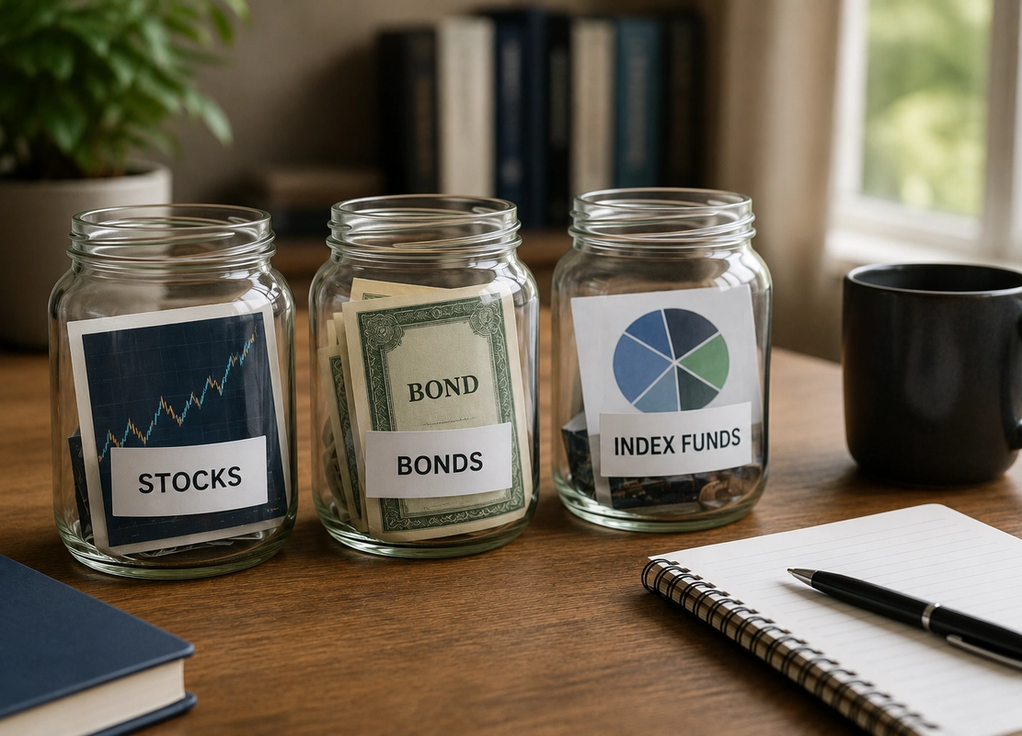
The Difference Between Stocks, Bonds, and Index Funds
By
Enzo Hinton
July 20, 2026
Latest
If you’re new to investing, the number of financial terms can feel overwhelming. Stocks, bonds, index funds, ETFs, mutual funds, dividends, and interest rates are often discussed as if everyone already understands them.
In reality, many people delay investing simply because they don’t know where to start.
The good news is that some of the most common investment options are relatively easy to understand once you break them down. Stocks, bonds, and index funds are three of the most popular ways to invest, and each serves a different purpose.
Understanding how they work can help you make more informed financial decisions and feel more confident about building long-term wealth.
What are stocks?
When you buy a stock, you’re purchasing a small ownership stake in a company.
If you buy shares of a publicly traded company, you become a shareholder. As the company grows and becomes more valuable, the value of your shares may increase. Some companies also distribute a portion of their profits to shareholders through dividends.
Stocks have historically provided some of the highest long-term investment returns, which is why they are often considered an important part of wealth building.
However, stocks also come with risk. Company performance can fluctuate, economic conditions can change, and stock prices can rise or fall significantly over short periods.
Because of this, stocks are generally considered suitable for investors who can tolerate some level of volatility and are investing for the long term.
What are bonds?
A bond is essentially a loan.
When you buy a bond, you are lending money to a government, municipality, or corporation. In return, the issuer agrees to pay you interest and return your original investment at a specified future date.
Unlike stocks, bonds do not provide ownership in a company. Instead, they generate income through interest payments.
Bonds are often considered less risky than stocks because they typically offer more predictable returns. However, lower risk generally comes with lower potential rewards.
For this reason, many investors use bonds to help balance risk within their portfolios, particularly as they approach retirement or other financial goals where preserving capital becomes more important.
What are index funds?
An index fund is a type of investment fund that holds a large collection of stocks, bonds, or other assets.
Rather than trying to outperform the market, an index fund simply aims to track the performance of a specific market index. For example, some index funds follow large groups of companies, giving investors exposure to hundreds or even thousands of businesses through a single investment.
This diversification is one of the main reasons index funds have become so popular.
Instead of relying on the success of a single company, investors spread their risk across many different businesses and industries. If one company performs poorly, the impact on the overall fund is usually limited.
Many financial experts consider index funds one of the simplest and most effective ways for beginners to start investing.
Comparing risk and potential return
One of the biggest differences between stocks, bonds, and index funds is their balance between risk and potential reward.
Individual stocks often offer the highest growth potential but can also experience significant price fluctuations. A single company may perform exceptionally well, but it can also struggle or even fail.
Bonds generally provide more stability and predictable income, but their long-term growth potential is usually lower.
Index funds often sit somewhere in between. Because they contain many investments, they reduce some of the risk associated with individual stocks while still providing exposure to market growth.
This balance is one reason why many investors choose index funds as a core part of their investment strategy.
Why diversification matters
The phrase “don’t put all your eggs in one basket” is frequently used in investing, and for good reason.
Diversification helps reduce risk by spreading investments across multiple assets. Instead of relying on a single company, industry, or investment type, diversified portfolios are designed to withstand fluctuations more effectively.
Index funds naturally provide diversification because they include many different holdings. Investors may also diversify further by combining stocks, bonds, and index funds within the same portfolio.
The right mix depends on factors such as age, financial goals, risk tolerance, and investment timeline.
Which option is best for beginners?
There is no single investment that is right for everyone.
However, many financial professionals recommend index funds for beginners because they offer broad diversification, relatively low costs, and a straightforward approach to investing.
Individual stocks can be appealing for investors who enjoy researching companies and are comfortable with greater risk. Bonds may be useful for those seeking stability and income.
For many people, a combination of these investments provides the best balance between growth and risk management.
The key is understanding what each option does before deciding how it fits into your overall financial plan.
Investing doesn’t have to be complicated
Stocks, bonds, and index funds may sound intimidating at first, but their basic concepts are surprisingly simple.
Stocks allow you to own part of a company. Bonds allow you to lend money and earn interest. Index funds allow you to invest in many assets at once through a single investment.
Each has advantages, risks, and potential uses depending on your goals.
The most important step is not choosing the perfect investment immediately. It’s taking the time to understand your options and beginning to invest consistently.
Over the long run, knowledge, patience, and consistency often matter far more than trying to predict the next big market winner.