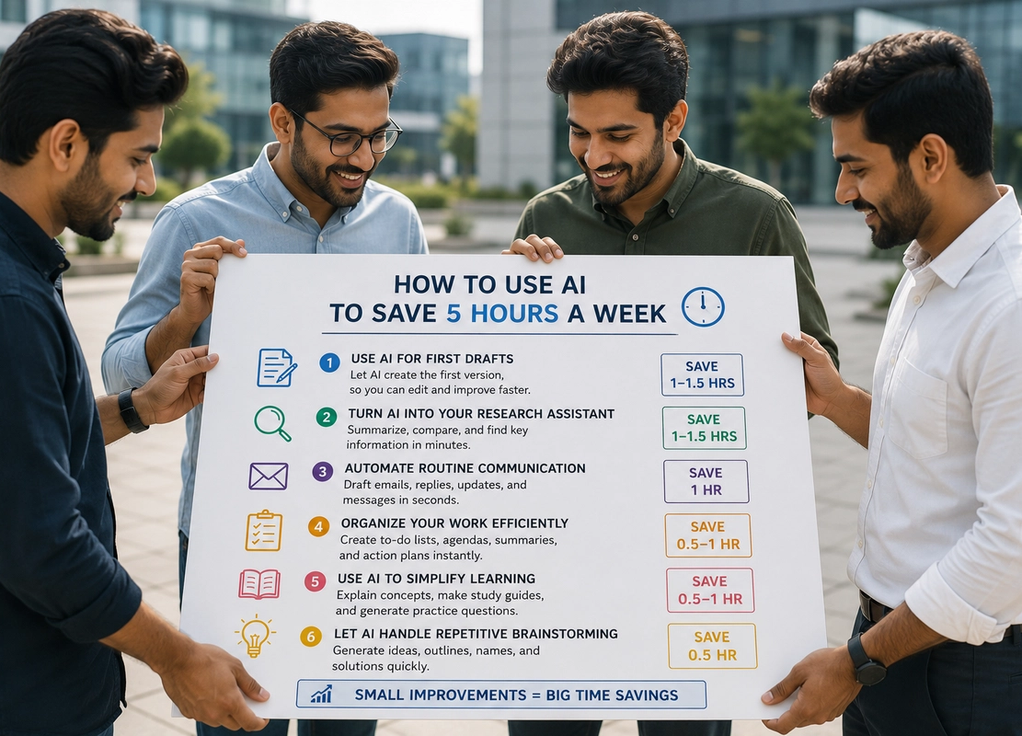
How to Use AI to Save 5 Hours a Week
By
Adaline Brock
July 20, 2026
Latest
Artificial intelligence has quickly become one of the most talked-about technologies in the world. Yet despite the excitement, many people still use AI only occasionally—or not at all. They may ask it a few questions, generate some text, or experiment with a chatbot, but they haven’t figured out how to make it genuinely useful in their daily lives.
The reality is that AI can be a powerful time-saving tool when used strategically. It won’t replace critical thinking, creativity, or human judgment, but it can help automate repetitive tasks, speed up research, improve organization, and reduce the amount of time spent on routine work.
You don’t need to be a programmer or technology expert to benefit. In many cases, a few simple habits can save several hours every week.
Use AI for first drafts
One of the biggest time drains in both professional and personal life is starting from a blank page.
Whether you’re writing an email, creating a report, drafting a proposal, planning a presentation, or preparing social media content, AI can help generate a starting point. Instead of spending thirty minutes figuring out how to begin, you can ask AI to create an outline, summarize key ideas, or draft an initial version that you can edit and improve.
The goal isn’t to copy and paste everything AI produces. It’s to eliminate the time spent staring at an empty document and accelerate the creative process.
For many people, this alone can save several hours each week.
Turn AI into your research assistant
Research often involves reading multiple articles, comparing information, identifying key points, and organizing findings.
AI can help simplify this process by summarizing information, explaining complex topics, comparing options, and highlighting important insights. Rather than spending hours gathering basic information, you can use AI to create an overview and then focus your attention on verifying facts and making decisions.
This approach is especially useful for professionals, students, entrepreneurs, and anyone who regularly works with large amounts of information.
Less time spent gathering information means more time spent using it effectively.
Automate routine communication
Many daily messages follow predictable patterns.
Meeting requests, follow-up emails, client updates, project summaries, customer responses, and internal communications often require similar structures. AI can help draft these messages in seconds, allowing you to focus on reviewing and personalizing them rather than writing each one from scratch.
This doesn’t mean removing the human element from communication. Instead, it allows you to spend less time on repetitive formatting and more time on the content that actually matters.
Small savings on individual emails can add up significantly over the course of a week.
Organize your work more efficiently
AI can also function as a personal productivity assistant.
It can help create to-do lists, organize projects, prioritize tasks, develop meeting agendas, summarize notes, and break large goals into manageable steps. Many people waste time deciding what to do next rather than actually doing the work.
Using AI to create structure can reduce that friction.
A clear plan often leads to faster execution and fewer hours spent switching between tasks or feeling overwhelmed by competing priorities.
Use AI to simplify learning
Learning new skills often requires sorting through large amounts of content before finding the information you actually need.
AI can accelerate this process by explaining unfamiliar concepts, creating study guides, summarizing books, generating practice questions, and breaking down complicated topics into simpler language.
Whether you’re learning a new software tool, exploring a business concept, or studying for a certification, AI can help reduce the time spent searching for answers.
This allows you to spend more time applying knowledge rather than hunting for it.
Let AI handle repetitive brainstorming
Brainstorming can be valuable, but it can also consume more time than necessary.
AI is particularly useful for generating ideas quickly. It can suggest article topics, marketing campaigns, business names, content outlines, meeting themes, travel itineraries, and creative solutions to common problems.
You don’t need to use every suggestion. Often, a few ideas are enough to spark your own thinking and move a project forward.
The goal is not replacing creativity but accelerating it.
Know when not to use AI
While AI can save significant amounts of time, it’s important to recognize its limitations.
Important financial decisions, legal matters, medical concerns, strategic business decisions, and highly specialized work still require human expertise and judgment. AI can assist with information gathering and organization, but it should not replace professional advice or critical thinking.
The most effective users treat AI as a tool rather than an authority.
Understanding where AI adds value—and where it doesn’t—is part of using it wisely.
Small improvements create big savings
Most people don’t suddenly save five hours a week by using AI once.
The time savings come from dozens of small improvements throughout the week. Saving ten minutes on an email, fifteen minutes on research, twenty minutes on planning, and thirty minutes on writing quickly adds up.
Over time, those small efficiencies can free up several hours that would otherwise be spent on repetitive tasks.
The result isn’t necessarily working more. It’s having more time available for the work that requires your attention, creativity, and expertise.
Work smarter, not harder
AI is not a shortcut to success, but it is a powerful tool for reducing unnecessary effort.
When used thoughtfully, it can help streamline communication, speed up research, improve organization, support learning, and eliminate many of the small tasks that consume valuable time throughout the week.
The people benefiting most from AI are not those who use it for everything. They’re the ones who use it strategically for the tasks that don’t require their full attention.
Because the real value of AI isn’t doing your work for you—it’s giving you more time to focus on the work that matters most.