How to Spot AI-Generated Content (Even When It’s Good)
By
Maia Craig
July 20, 2026
Latest
Artificial intelligence can now write articles, generate images, create videos, draft emails, and even produce entire marketing campaigns in seconds. As the technology improves, distinguishing between human-created and AI-generated content is becoming increasingly difficult.
In fact, many of the best AI-generated pieces no longer contain the obvious mistakes that once gave them away. Grammar is polished, sentences are coherent, and the information often appears accurate.
So does that mean it’s impossible to tell the difference?
Not quite.
While there is no foolproof method for identifying AI-generated content, there are certain patterns and characteristics that often appear—even in high-quality outputs. Understanding these signs can help you become a more critical consumer of digital content.
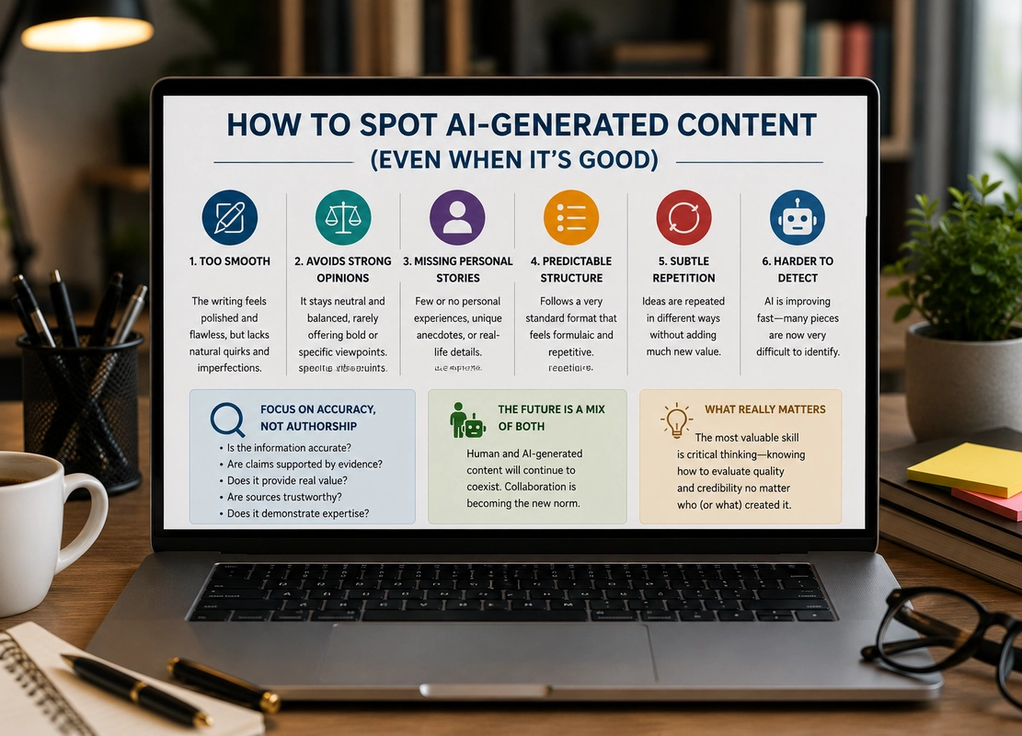
The writing often feels strangely smooth
One of the most common characteristics of AI-generated content is that it reads very smoothly.
At first, this sounds like a positive thing. The sentences are usually grammatically correct, logically organized, and easy to follow. However, after reading several paragraphs, some people notice that the writing feels almost too polished.
Human writing often contains quirks, unexpected observations, personal experiences, unusual phrasing, or small imperfections that give it personality. AI-generated writing can sometimes feel more uniform and predictable.
The content may be clear and competent, but it occasionally lacks the distinctive voice that makes human writing memorable.
It tends to avoid strong opinions
Most AI systems are designed to provide balanced and broadly acceptable responses.
As a result, AI-generated content often avoids taking bold positions or expressing highly specific viewpoints. Instead, it may present multiple sides of an issue and conclude with a moderate, reasonable summary.
Human writers, on the other hand, frequently reveal personal perspectives, biases, preferences, and experiences. These elements create individuality and make content feel more authentic.
When an article consistently stays in the middle of every argument without offering unique insights, it may be a sign that AI was involved.
Personal stories are often missing
One of the easiest ways humans build credibility and connection is through personal experience.
A writer might describe a mistake they made, a lesson they learned, a conversation they had, or a challenge they faced. These details create a sense of authenticity because they reflect lived experience.
AI does not have real experiences.
While it can generate fictional anecdotes or imitate personal storytelling, genuinely specific and verifiable personal experiences are much harder to replicate convincingly.
When content discusses topics entirely in general terms without any unique human perspective, it can sometimes feel AI-generated.
The structure is often very predictable
AI is remarkably good at organizing information.
Many AI-generated articles follow a highly structured format: introduction, explanation, examples, balanced discussion, and conclusion. While this organization can improve readability, it can also make content feel formulaic.
Human writers occasionally break patterns. They may begin with an unexpected story, introduce surprising ideas, or explore topics in less predictable ways.
AI often prioritizes clarity and consistency over originality, which can make multiple pieces feel similar even when the subjects are different.
Repetition can appear in subtle ways
As AI models generate longer pieces of content, they sometimes repeat ideas using slightly different wording.
An article may introduce a concept, explain it, revisit it later, and then summarize it again without adding much new information. The repetition is often subtle enough that readers don’t immediately notice it, but the overall effect can make the content feel longer than necessary.
Human writers can be repetitive too, of course. However, AI-generated content often repeats concepts because it prioritizes reinforcement and completeness.
The result is content that is informative but occasionally redundant.
AI is becoming harder to detect
It’s important to recognize that the signs mentioned above are becoming less reliable as AI systems improve.
Many professional writers now use AI as a drafting, editing, or brainstorming tool. As a result, much of today’s content exists somewhere between fully human-created and fully AI-generated.
A skilled human editor can significantly improve AI-generated text, while a human writer may use AI assistance without readers ever realizing it.
The line between human and machine-created content is becoming increasingly blurred.
This is one reason why many experts believe the future conversation will focus less on detection and more on transparency.
Why accuracy matters more than authorship
In many situations, the quality and accuracy of content matter more than whether it was generated by AI.
An article written entirely by a human can contain errors. An AI-assisted article can be well-researched and highly useful. The opposite can also be true.
Rather than focusing exclusively on who—or what—created the content, readers should evaluate:
- Is the information accurate?
- Are claims supported by evidence?
- Does the content provide real value?
- Are sources trustworthy?
- Does it demonstrate expertise?
Critical thinking remains essential regardless of the content’s origin.
The future will be a mix of both
The internet is likely moving toward a future where human and AI-generated content coexist.
Some content will be written entirely by people. Some will be generated entirely by AI. Much of it will be created through collaboration between humans and machines.
As a result, identifying AI-generated content may become less important than understanding how to evaluate information effectively.
The most valuable skill will not be spotting AI every time. It will be learning how to assess quality, credibility, and usefulness regardless of who—or what—produced the content.
Because in the years ahead, the question may no longer be whether AI helped create something.
The question will be whether the content is worth your attention.