How to Protect Your Business from Cybersecurity Threats
By
Vance Byrd
July 20, 2026
Latest
Cybersecurity is no longer a concern reserved for large corporations and technology companies. Today, businesses of all sizes face digital threats that can disrupt operations, damage reputations, and result in significant financial losses.
Many small business owners assume they are unlikely targets because they don’t handle massive amounts of data or operate on a global scale. In reality, smaller businesses are often attractive targets precisely because they may have fewer security measures in place.
The good news is that protecting your business doesn’t require an enormous budget or a dedicated cybersecurity team. Many of the most effective security practices are straightforward and can significantly reduce risk when applied consistently.
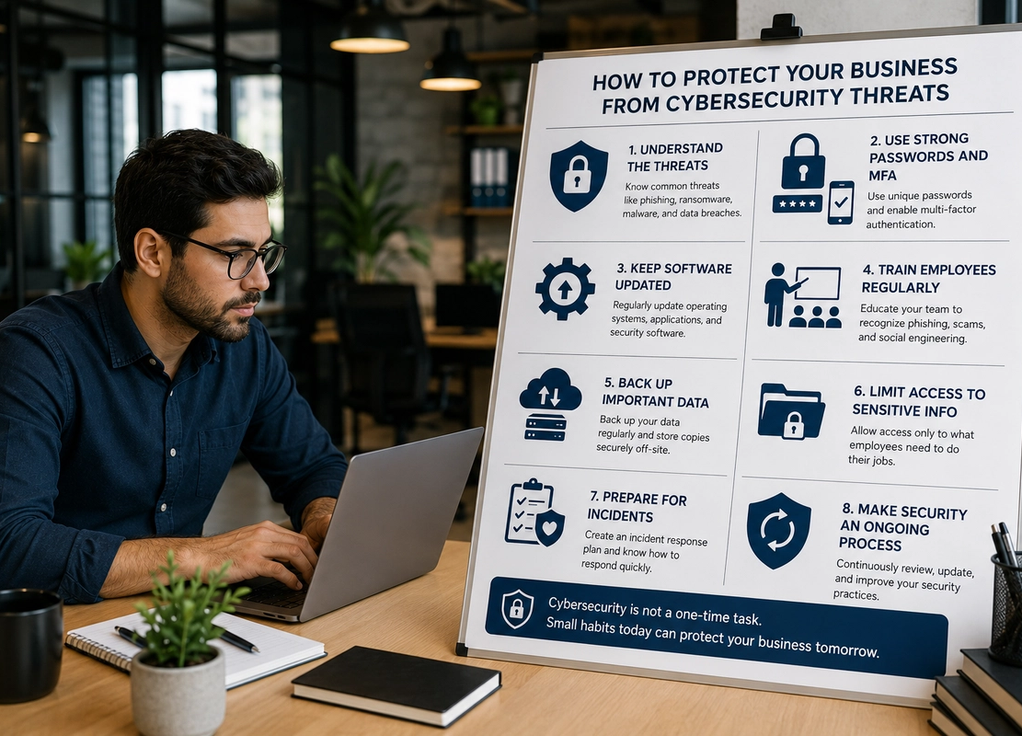
Understand the most common threats
The first step in improving cybersecurity is understanding what you’re protecting against.
Some of the most common threats include phishing emails, ransomware, malware, stolen passwords, data breaches, and social engineering attacks. In many cases, cybercriminals aren’t exploiting sophisticated technical weaknesses—they’re taking advantage of human error.
An employee clicks a suspicious link, reuses a weak password, or shares sensitive information with someone pretending to be a trusted contact. These seemingly small mistakes can create serious security problems.
Understanding common threats helps employees recognize risks before they become incidents.
Use strong passwords and multi-factor authentication
Passwords remain one of the most important lines of defense for any business.
Weak or reused passwords make it easier for attackers to gain unauthorized access to systems, accounts, and sensitive information. Every employee should use strong, unique passwords for business accounts.
Password managers can help simplify this process by generating and securely storing complex passwords.
Businesses should also enable multi-factor authentication whenever possible. This additional layer of security requires users to verify their identity through a second method, such as an authentication app or temporary code.
Even if a password is compromised, multi-factor authentication can significantly reduce the likelihood of unauthorized access.
Keep software and systems updated
Software updates can be inconvenient, but they serve an important purpose.
Many updates contain security patches that fix vulnerabilities discovered after software is released. Delaying updates can leave systems exposed to known weaknesses that attackers actively target.
Businesses should regularly update:
- Operating systems
- Web browsers
- Applications
- Security software
- Mobile devices
- Network equipment
Automating updates where possible can help ensure that important security fixes are not overlooked.
A fully updated system is generally much harder to exploit than one running outdated software.
Train employees regularly
Technology alone cannot solve cybersecurity problems.
Employees play a critical role in protecting business systems and information. Even the most advanced security tools can be undermined by a single careless click or poor security decision.
Regular cybersecurity training helps employees recognize phishing attempts, suspicious links, fraudulent messages, and social engineering tactics. It also reinforces best practices for handling sensitive information.
Creating a culture of security awareness can significantly reduce risk across the organization.
Cybersecurity is often as much about people as it is about technology.
Back up important data
Data is one of the most valuable assets many businesses possess.
Customer records, financial information, contracts, project files, and operational data can be difficult or impossible to replace if lost. Regular backups help ensure that critical information can be recovered following hardware failures, cyberattacks, or accidental deletion.
Businesses should maintain multiple backups and store copies separately from their primary systems.
The ability to restore data quickly can dramatically reduce disruption if an incident occurs.
Backups may seem unnecessary until the day they’re needed.
Limit access to sensitive information
Not every employee needs access to every system.
Limiting access based on job responsibilities helps reduce the potential impact of security incidents. If an account is compromised, attackers can only access the information available through that account.
Businesses should regularly review permissions and remove access that is no longer necessary.
This principle, often referred to as “least privilege,” is one of the most effective ways to reduce risk.
The fewer unnecessary access points that exist, the smaller the attack surface becomes.
Prepare for incidents before they happen
No organization can eliminate risk entirely.
That’s why businesses should have a plan for responding to cybersecurity incidents before they occur. Knowing who to contact, how to isolate affected systems, and how to communicate with customers or stakeholders can significantly improve outcomes during a crisis.
An incident response plan does not need to be complicated. Even a basic plan can help reduce confusion and improve decision-making during stressful situations.
Preparation often makes the difference between a manageable problem and a major disruption.
Cybersecurity is an ongoing process
One of the biggest misconceptions about cybersecurity is that it can be solved once and forgotten.
Threats evolve constantly. New vulnerabilities emerge, attackers develop new tactics, and technology continues to change. Effective cybersecurity requires regular attention and continuous improvement.
The goal is not to create perfect security. The goal is to make your business a more difficult target and reduce the likelihood of successful attacks.
Small improvements made consistently can have a significant impact over time.
Protecting your business starts with simple habits
Cybersecurity may seem complex, but many of the most effective protections are surprisingly practical.
Strong passwords, multi-factor authentication, software updates, employee training, data backups, and access controls can dramatically improve security without requiring enormous investments.
Businesses of every size face digital risks, but they also have opportunities to reduce those risks through preparation and awareness.
In the end, cybersecurity isn’t just an IT issue. It’s a business issue.
And the organizations that treat it as a priority are often the ones best positioned to grow, adapt, and thrive in an increasingly connected world.